Friday, June 24, 2011

Where's the Common Sense!? Where's the Sanity!? Who is Looking Out for Perú's Majority!?


The indefinite strike in the provinces of Melgar and Azángaro in Puno against mining and oil concessions turned violent Thursday.

Thursday afternoon Walter Aduviri met with congressmen to seek a solution to the region's turmoil.

"We will radicalize the protest. We demand decontamination of the Ramis basin and the cancellation of mining and oil concessions," said Sergio Mamani, leader from the town of Progreso.
Read the full article here

=========================
Peru-N-English Opinion:

Why is Walter Aduviri meeting with congressmen and not sitting in jail awaiting trial!? The government should call for a halt of all terrorist activities, and the surrender to authorities of their radicalized leaders, before negotiating any agreements. Are they going to wait for more people to be needlessly killed, more property to be destroyed and more groups to become emboldened and radicalized?
  ------------------
PUNO UPDATE 6/24/2011: 
------------------

Why is no one methodically and scientifically questioning the accusations and claims against legitimate businesses, allowed to be held up unchallenged as truth, by these dangerous and hateful ignorant minority groups? I'm not talking about bias media reports. Where are the uncolored by ideology proven facts?

These rioters are calling for the clean up of the Ramis River Basin in Puno. That’s fine and should be addressed more quickly. There are already studies underway attempting to remedy this long term problem and the contamination of Lake Titicaca. But what does that have to do with the Bear Creek Mining Santa Ana project or any other professional, modern technology, drilling or mining operations that have invested hundreds of millions of dollars to protect the environment in Perú? Absolutely nothing!  Read below:


=======================

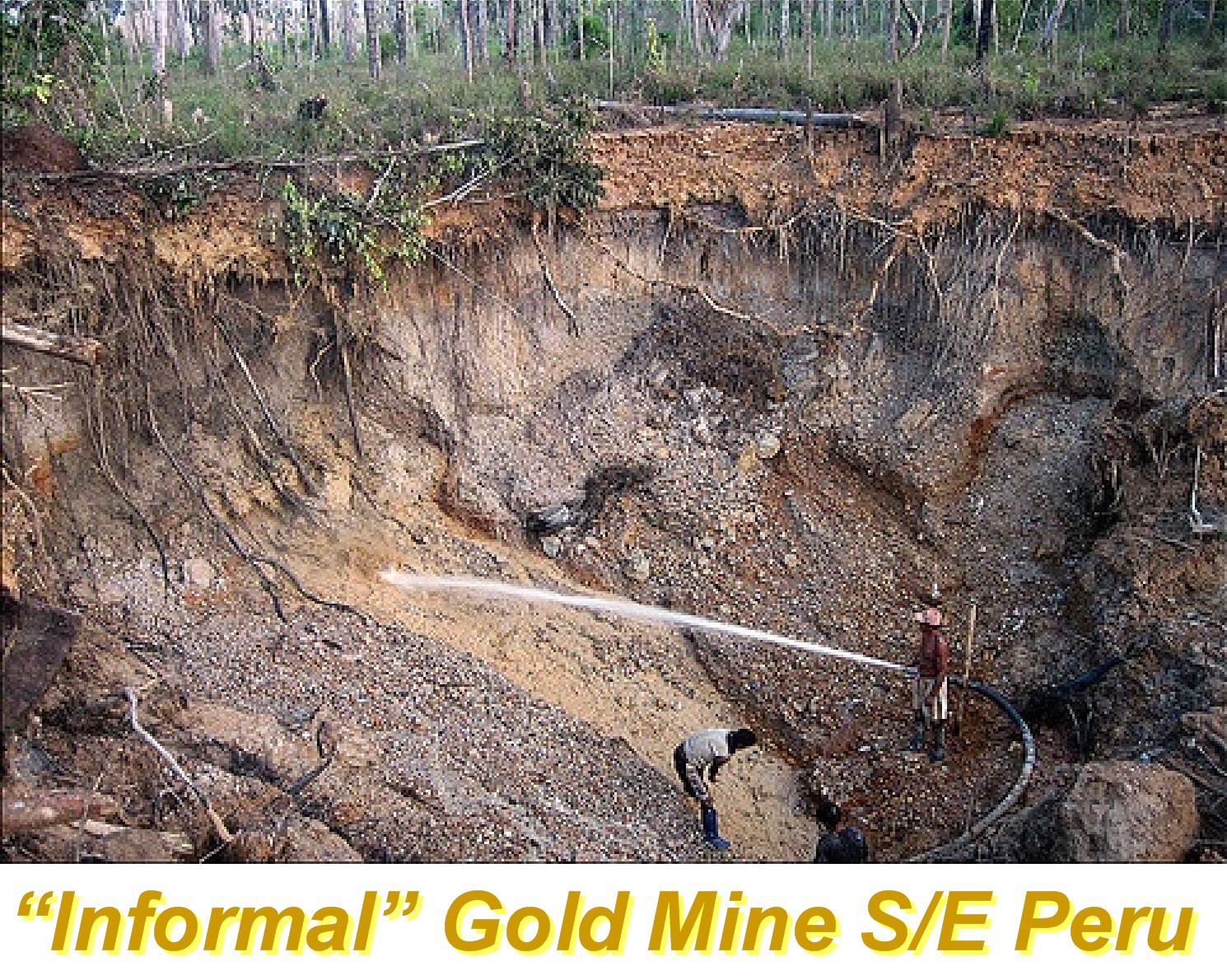
“Informal” gold mining in southern Puno region has been impacting the Ramis river basin for years and the formation of a committee to address the high levels of pollution in the basin is nothing new. As far back as 2003, the government announced a plan to clean up Titicaca and the polluted rivers, costing millions of dollars.

Continued ...

In 2005, local authorities from Puno's Azángaro province presented a petition in congress calling for the intervention of the energy and mining ministry (MEM) in the mining activities polluting the area.
In response, the health ministry recommended the formation of a multi-sector committee, headed by MEM to resolve the issue. 


In early 2006, the committee decided to carry out studies of the river basin to evaluate the situation. The levels of heavy metals such as copper, chrome, lead, mercury and zinc were found to be higher than legally permitted under the country's water law.


In April of the same year, hundreds of residents in the basin area marched to the regional capital of Puno to protest against the contamination and urge authorities to shut down the mining centers.

In October 2006 MEM issued a statement saying it had organized a multi-sector committee to resolve environmental problems caused by informal gold mining.

To prevent further pollution of the Ramis river basin, the ministry along with miners, the Puno government and the municipalities of Ananea and Putina, pledged to fund a system to stabilize suspended solids in wastewater discharges.

The ministry said it expected construction of this system to take some four months. MEM also said it expected congress to draft a law further regulating environmental issues related to mining in Puno.

In July 2007 the Peruvian government approved by decree a plan to prevent further pollution of the Ramis river basin.

The first step in the plan was to increase police presence in the area and restrict the illegal sale of explosives and fuel that has facilitated informal mining.

The government also said it would open an office in the Ananea community, where the contamination was occurring, to oversee local mining practices.

In late 2008, the country formalized the creation of Minam. The ministry has promised to focus on cleaning up river basins and formalizing illegal mining activities.


 =====================
  
This is a case of Peruanos contaminating Peruanos 
Not legitimate outside mines contaminating Peruanos
Where's the Common Sense!? Where's the Sanity!? 
Who is Looking Out for Perú's Majority!? 
A majority who have benefited greatly from outside mining and drilling.

 Comments posted here may be copied to the Peru-N-English Discussion Group site.

Thursday, June 23, 2011

Walter Aduviri (Puno terrorist leader), “Permanently cease all mining concessions in the Puno region.”

From Living in Peru

Government reviews Supreme Decree

===================================


 WAKE UP PERU!

For the sake of all the millions of people and families in Perú who have prospered due to mining and drilling operations throughout the country, Perú’s government needs to grows a pair and not let a few thousand ignorant terrorist types dictate government and investment policy with false and unsubstantiated claims.

Billions of dollars that have reduced poverty, enhanced education, brought modern medicine advancements, constructed housing and grown the middle & upper classes of Perú are at stake. If Perú’s government doesn’t take a stand at this juncture the whole investment picture in Perú becomes murky and questionable. And the terrorists become legitimized and emboldened to conduct more anarchist based extortion in the future. Walter Aduviri needs to go to prison for his crimes and threats of further terrorism against the government of Perú.


Comments posted here may be copied to the Peru-N-English Discussion Group site.

Wednesday, June 22, 2011

Humala's Self-Inflicted Crisis

==============================
(Reuters) - Three people died when police clashed with students who set fire to government buildings in a remote province, officials said on Wednesday, a sign of social conflict looming for leftist President-elect Ollanta Humala. They set fire to almost all of the offices of the regional government. 

Huancavelica rioters raided the morgue for the bodies of the three persons killed (one a 14 year old girl) during their hate filled terrorist actions. Then they paraded them in their coffins through the streets of Huancavelica trying to blame police for the results of their own violent deeds. This is only one of more than 220 terrorist driven anarchist actions taking place in Perú since the victory of President-elect Ollanta Humala.

In my opinion, it is President-elect Ollanta Humala’s irresponsible campaign words validating the rightfulness of the (unsubstantiated) claims these anarchist groups are making, against the perceived evil government and good faith industries of Perú, that have opened the door and fueled the flames of all these riots and uncivil disobedience. These are Humala's supporters and voters. Why does he not step up and condemn these terrorist actions? Where is his leadership? Where is his love of Perú? This far flung unrest has provided an excellent opportunity for foreign infiltrators and agitators to enter the fray. Reports have confirmed this. President-elect Ollanta Humala is frantically and absurdly calling on the outgoing President Alan Garcia (with one month left in office) to fix all these problems that Humala himself incited. So far Humala’s publicly announced plan to deal with the situation is the resolution of demands by talking with each group. 

 ================================

Wednesday, June 22, 2011

Peru-N-English Opinion:

Humala incited and inflamed the current riots and acts of terrorism, or euphemistically called “social conflicts” by sympathizers, with his outrageous promises. Soon it will be time to pay the piper. This kind of pressure is notorious for causing ill-informed, economically imprudent and reckless decision making.

Humala is already preposterously pleading for Garcia to fix (in his few remaining days) the Puno problem
before Humala (himself) takes office. These are obviously Humala supporters. He stirred them up to get their vote, shouldn't he be going to Puno to calm them down? It is obvious that Puno is going to be a long term problem, that will require a thoughtful process and that will need to be addressed by the incoming administration. You’d think someone who is about to become president would know that.

Attempts to pacify active terrorists’ arguments tend only to embolden them and other terrorist groups while broadening the lunacy of their demands. Before steps can be taken or policies moved forward, to address any realistic concerns of these affected communities, the government must demand and enforce that all the acts of terrorism be halted immediately and indefinitely. Anarchy and chaos should never be rewarded.


Humala’s apparent (up to this point) impulsiveness for saying whatever the group immediately in front of him wants to hear, works only in campaigns to gain the votes of ignorance, not in real life situations. Humala needs desperately to show a strength and conviction in that only peaceful requests will be heard, and that all terrorism will be met with overwhelming force.  I sincerely hope that Humala’s incoming “Dream Team” is far more than just a dream. The World is watching!

Comments posted here may be copied to the Peru-N-English Discussion Group site.

Liar! Liar! Pants On Fire! But They're Not Burning On "Barato" (Cheap) Gas


Humala has already, since being elected, backtracked on the promise of bidónes of gas for S/.12 each. Actually saying, he never promised bidónes of gas for S/.12 each. You can be the judge. Maybe Humala should send some people out to take down his political campaign signs that advertised bidónes of gas for S/.12 each? They’re still up in many locations. Especially where the poorer folks live. Most intelligent people knew that S/. 12 gas was not a sound policy based in economic reality. But most of the poorer folks around here, I talked with, were really excited about bidónes of gas for S/. 12 as they headed off to the polls to vote. “Ollanta! Presidente! Ollanta! Presidente! Ollanta! Presidente!”

Comments posted here may be copied to the Peru-N-English Discussion Group site.

Thursday, June 16, 2011

Puno’s Extorsiónistas

June 16, 2011
Violence, lawlessness, destruction of property and intimidation are proven effective tools against Perú authorities as they back down and Puno terrorist leader Walter Aduviri walks free.
===============

 
PUNO TERRORISM

No different than an old Mafia movie. The wealthy, hard working and legitimate business man moves into a rough area to start up a new business. Then next he is visited by the local Mafia thugs wanting to extract protection money for the mob. They tell the businessman, “You have violated the neighborhood rules by moving in without talking to the folks around here. You understand, don’t you? The neighbors say they don’t feel like you fit into our little neighborhood. You could be subject to violence and your family may be in danger. But don’t worry. We’re here to help you out. You just have to give us some of your profits and we will keep these awful people off your back.”  That’s Puno. Yes, I know, many of these people are holding the false flags of agriculture and environment. But since neither of these concerns are realistic nor would be impacted by the new Puno, Santa Ana mine, I think it is safe to say that monetary reparations would rip the heart out of anymore riots near term. And would most assuredly assuage the criminal, Walter Aduviri. But it would set a horrible future precedent.


The Truth:

The Santa Ana (Puno) property, of Bear Creek Mining, in dispute is located 140 km (87 miles) south of the city of Puno, 20 km (12.5  miles) south of the paved highway connecting to the port of Ilo, Peru. It isn't even in the same drainage basin as Lake Titicaca nor Puno‘s water supplies. There are already to other highly functioning mines in the area. Two of them are the Cuajone and Toquepala mines. Neither of these mines have neglected nor destroyed the environment. They have invested hundreds of millions of dollars to protect the environment. Does anyone truly believe that the Peruvian government, which has difficulty containing corruption and managing itself, would make those kind of investments, if the mines were turned over to them? Let’s not be absurd!

Factual not Emotional:

The Cuajone mine, located in the rugged Peruvian Andes at 12,000 feet, was the largest single copper mine and smelter complex ever built. Fluor provided detailed engineering, procurement and construction management services along with training for 7,000 peak “local” workers.
SOURCE


Reporting from Peru in 1992, Nathaniel C. Nash of the New York Times wrote that Southern Peru Copper's 5,000 workers and their 20,000 dependents received free housing, education, electricity, water, medical care, and food at the mines and Ilo. The company also was subsidizing college education for the children of its workers. 'A tour through both Cuajone and Toquepala,' he continued, 'found them to be more like modern rural United States towns, with manicured lawns, clean buildings and streets. The hospital in Cuajone is considered perhaps the most modern in Peru.' Nevertheless, he noted, 'Recent surveys have found that 75 percent of the residents do not like the presence of this American corporate giant, dubbed by some as the `gringo octopus.'
SOURCE

During its long history, Southern has continued to modernize and improve its operations but not only to increase production. The company has spent hundreds of millions of dollars on environmental controls including modernization of the Ilo copper smelter which represents the largest environmental expenditure in Peru's history ($600 million).
SOURCE


University training and involvement: The 2005 edition, was for the second time (after the 2002 edition) completely devoted to the geochemical and geomicrobiological aspects of mine waste management. During the six days of lectures, a broad overview about the environmental problems of mining activities with special focus on the formation, control and prevention of acid mine drainage was given.

Toquepala porphyry copper deposit and the remediation approach at the Bahía de Ite tailings deposit (Southern Peru Copper Corporation) were visited to show the complete mining process from the mineral extraction in the open pit, through crushing, milling, flotation, to the tailings disposal, and mine waste remediation in these world class deposits.
SOURCE

Back to Puno:

We have wealthy, hard working, legitimate and ethical Bear Creek Mining Company, that has followed the laws and regulations, and has committed to (and in some case surpassed) the world’s most stringent environmental controls, moving into the rough Puno area. The privately owned mines in Perú are largely the impetus behind Perú’s astounding rise in world status, societal wealth and reduced poverty. Bear Creek Mining Company wants to move into an area already occupied by successfully functioning and environmentally responsible mines. They have spent millions already in feasibility and environmental studies. Now the Puno criminal Mafia, with the aid of activists from outside of Perú and ignorant Puno residents (with the mentality of lemmings), starts waving around fictitious  claims of environmental concerns and damage.* What some of these criminals really want is to extort money from the local mines. Others, are just baseless xenophobic haters of the “gringo octopus.”  The Puno criminals threaten that if they are not appeased they will “radicalize” and endanger the prosperity of every resident in Perú. Why is this rebellion not crushed? Legitimate protests present the public with proof and facts, not violence. 

* The media has failed purposely, I suppose for reasons of ideology, to question any of the Puno rioters’ and terrorists’ claims or to present any actual mining facts or figures. Shameful!


Keep in mind that the terrorist leaders of the Puno riots are demanding that "ALL" mining and drilling operations be permanently shutdown.

Fear Mongering:

The one mine I hear brought up over and over again, as an example of an environmental disaster within Perú, is the La Oroya polymetallic smelter (now owned by Doe Run Mining). Nearly 90 years old, the government owned La Oroya mine for 23 years, during which time the pollution grew to unmanageable levels. The mine was then sold in a “too little too late” attempt to clean it up. It was established by the American Cerro de Pasco Corporation in 1922, was nationalized and became the property of Centromin in 1974 and was then privatized in 1997 when Doe Run bought it for US$247 million. It consists of a copper and lead smelter and zinc refinery.

When Doe Run bought La Oroya, it took over Centromin's PAMA, (Programa de Adecuación y Manejo Ambiental or Environmental Remediation and Management Program), an environmental contract requiring environmental remediation measures. The measures required new sulfuric acid plants, elimination of fugitive gases from the coke plant, use of oxygenated gases in the anodic residue plant, a water treatment plant for the copper refinery, a recirculation system for cooling waters at the smelter, management and disposal of acidic solutions at the silver refinery, an industrial wastewater treatment plant for the smelter and refinery, a containment dam for the lead mud near the zileret plant, a granulation process water at the lead smelter, an anode washing system at the zinc refinery, management and disposal of lead and copper slag wastes, domestic waste water treatment, and domestic waste disposal.

Because of the difficulty, and potential impossibility of the task, Doe Run Peru has been indemnified by Centromin (and guaranteed by the Peruvian Government) against any environmental liability arising out of Centromin's prior operation. Doe Run's original commitment to this program was US$107 million but it is now expected that it will cost at least US$244 million. The cleanup process continues today.
SOURCE

Related Post 1
Related Post 2
No surprise. Government owned companies are always a disaster.


Comments posted here may be copied to the Peru-N-English Discussion Group site.

Tuesday, June 14, 2011

Perú’s Pelosi

June 30, 2011 UPDATE:

Pope Benedict XVI prayed that the 121 foot-tall monument overlooking the city of Lima, Peru will “inspire everyone to grow in the love of God and neighbor.”

While the extremely far left, ideologically driven, kooky mayor of Lima, Susana Villarán, who claims to be a devout Catholic while working feverishly to advance abortion, prostitution and LGBT rights (at the expense of many substantive and badly needed projects in Lima), couldn't put together a kind word for the majority supported project. Susana Villarán appears to be more than just a bit conflicted.

Pope Benedict XVI prayed that the 121 foot-tall monument overlooking the city of Lima, Peru will “inspire everyone to grow in the love of God and neighbor.” He encouraged Peruvians to “work tirelessly in the building of an ever more just, unified and fraternal society, in a climate of respect and diligent collaboration in the search for the common good,” according to the newspaper El Comercio. The Pope's words came in a message for the blessing of the massive “Christ of the Pacific” statue on June 24.

Mayor of Lima, Susana Villarán said. "I'm Catholic; I don't have problems with the figure of Christ, but it would have been better to dedicate the resources to social investment," The mayor dismisses the statue as "a plastic copy of the Christ of Corcovado.

But
Susana Villarán's words seem infinitesimally small, spiteful and petty when compared to the message read by Cardinal Juan Luis Cipriani of Lima. “It’s very easy to find reasons to criticize. We could talk about so many investments — without getting into details in order to avoid stepping on anyone’s toes — so many areas where there is useless spending. I think this is a small expense because it is a donation,” the cardinal noted. He said his own personal intention regarding the project is “to reconcile and not divide.” 
===============

Looney Tunes 


Hookers trumping infrastructure
Absent on commitments of national pride
Distractions rather than accomplishments
Obstruction without contribution
Symbolism over substance
Where is the Villarán plan to materially improve Lima, Perú?
================

From Living in Peru 

Disagreement on giant statue of Christ to be installed in Lima

=========================

Obviously elitist liberal/progressive “secular politics” are alive and well in Lima.


Lima mayor, Susana Villarán, has asked president Alan García to consider moving the location of the new statue, known as "Christ of the Pacific," saying the statue will affect the view of the Morro Solar.

Of course we all know this is about secularism and politics. Not the unsightly tower obstructed skyline of Morro Solar. If it were a statue of Karl Marx, or another famous secular figure, would Susana Villarán be objecting?

Aren’t there more pressing issues in Lima, on which Mayor Susana Villarán, should expend her energy and diminishing political clout? I believe there are
(pollution, crime, corruption, traffic, social services, etc.). But then, chasing insignificance seems to be her passion. 

Final Thought:

I think this statue is a brilliant idea and will immediately become a point of local pride and a marvelous tourist attraction. It certainly doesn’t hurt the featureless, barren and tower struck skyline of Morro Solar. Anyone with an ounce of common sense knows that this beautiful gift is only exclusionary if you have a closed mind. I appreciate all points of view and symbols of devotion, from any belief or religion, promoting love, community spirit and tolerance. Perhaps the reason atheists have such a problem with people of all religions expressing their faith is because they have none to share. Thank you to all in Perú and Brazil who made this possible.


Comments posted here may be copied to the Peru-N-English Discussion Group site.

Saturday, June 11, 2011

A Model For Perú

 Sorry for the gratuitous and misleading photo. The model I’m interested in today is a model to actually reduce poverty in Perú, or anywhere else, long term. 

A Couple of Quotes First
===================================
"I am for doing good to the poor, but I differ in opinion of the means. I think the best way of doing good to the poor, is not making them easy in poverty, but leading or driving them out of it. In my youth I traveled much, and I observed in different countries, that the more public provisions were made for the poor, the less they provided for themselves, and of course became poorer. And, on the contrary, the less was done for them, the more they did for themselves, and became richer.”

Benjamin Franklin
--
"You know, if you were a slave in the old South, what did you get as a slave? You got free room and board, you got free money, and you got rewarded for having children because that was just, you know, tomorrow's slave ...
Can I ask a question? How's that different from welfare? You get a free house, you get free food, and you get rewarded for having children. Oh, wait a minute, hold on a second. There is a difference: The slave had to work for it."

Jim Quinn
============================= 
This article, “Brazil reduces poverty but industry feels the strain” (posted by jorcaryvan at Peru-N-English Discussion Group) is a good example of how government redistribution always has negative economic consequences that defeat the whole purpose of the program. When governments give money and receive little or no productive activity in return they unbalance the economic system needed to genuinely and permanently lift people out of poverty. Not to mention the  debilitating effect it has on the poor by creating a sense of entitlement and ingrained poverty. When in history did the lives of poor people improved, when business was bad?

As long as poverty is politicized it will not be alleviated. The answer, in my estimation, is results and performance based, career or job focused, privatization of anti-poverty programs. With government playing only an oversight role in these organizations. There are private groups now that play this role, but most are highly atrophied due to the lack of proper funding.

What I propose is incentive based tax credits to businesses who become directly involved in establishing or funding anti-poverty and poverty to jobs programs. With two distinct obligations.
1. The names of these participating businesses and the anti-poverty programs they are associated with would have to be made public information.
2. The anti-poverty organizations would have to address both rural and urban poverty to qualify for a charter. And, independently audited results would have to be published semi-annually.

Government needs to step aside by giving direct rewards to businesses, large and small, for participation in or the creation of these programs. For example: For every $1 a business puts toward funding or organizing poverty eradication programs they would receive (for illustration purposes only) $1.05 in refundable tax credits up to 100% of their total annual tax obligation. I have no idea what the differential should be per country, but in looking at the USA chart below (because it is the only one I could find), I would tend to believe that it could be much larger than $1.05. When you consider the productivity that this tax credit program could produce, the change in costly criminal and social behaviors and the balancing of a country’s economic metrics, the overall savings to society, in general and in lifestyle improvement, would be unmeasurably positive.


Why would this work?

1. This is removing the social agendas of various political factions. Who like to use these poverty programs for social engineering and self-interested political gain. And, even in some cases, self-enrichment.

2. This is creating competition between the providers of the anti-poverty programs and would deliver performance based results. The best programs would rise to the top by natural selection. Businesses who create or support a private antipoverty program would have skin in the game. The results would be a direct reflection on their company. Thereby, holding their feet (and reputation) to the performance fire. 

3. Businesses have the ability to offer job or career paths in the productive private sector to those who earn it. This type of program would give them access to lots of otherwise undiscovered talent. Governments can only offer government jobs and careers that produce nothing and feed increasingly off the taxpayers.

4. Competing programs have a way of sorting out the good from the bad. The producers from the non-producers. Whereas government programs, once set in place, tend to become entrenched, inflexible and frozen by the infighting between political ideologies.


Could it happen? As long as you have politicians with egos that outweigh their benevolence, it is highly unlikely. Taxes and government run programs are power and control to politicians and bureaucrats. They won't give that up easily. Thanks to politicians everywhere, the odds on favorite is that, poverty will continue to thrive. After all, when in history has a government anti-poverty program successfully reduced poverty while maintaining low taxes and a competitive growth rate? To solve the poverty problem, government needs to stop vilifying business and commerce, as the evil rich (for the political purpose of raising taxes on them), and start creating direct management anti-poverty and impoverished community economic growth programs, that utilize and solicit the knowledge and expertise of the business community.


ADDITIONAL FOOD FOR THOUGHT


Comments posted here may be copied to the Peru-N-English Discussion Group site.